
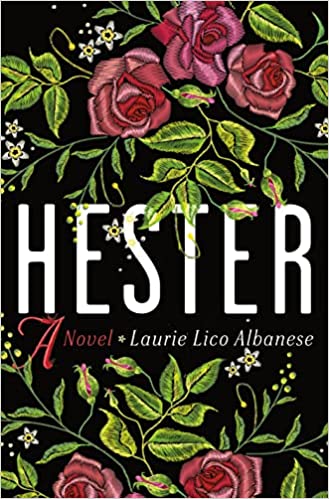
In Hester, Laurie Lico Albanese creates a hypnotic world where we’re invited to consider contrasting themes of past and present, desire and pain, hope, disappointment, freedom, and constraint. It’s also a story of creator and muse, as Albanese imagines what might have been the inspiration behind Nathaniel Hawthorne’s Scarlet Letter and its heroine Hester Prynne.
As that inspiration, Isobel is a character I found easy to care about. She is warm, intelligent, and talented. But she also makes mistakes, sees her own weaknesses, and changes in response to lessons learned. I appreciate her emotional journey in this book. There is a strong feminist current throughout the book as Isobel comes to better understand herself and her place in the world.
I also appreciated becoming more familiar with synesthesia (which Isobel experiences) and the intricacies of embroidery and dressmaking through her character.
Hawthorne – Hathorne, or “Nat” – actually became a distraction for me in this book. He is so brooding and melodramatic. It’s easy to see how Isobel mistakes his charm for depth, but that quickly unravels as his cowardice and selfishness are exposed. Even though he’s the one who achieves fame in the real world, here he feels like a caricature and plot device, serving only to get Isobel where she needs to be in her own story. [Which might just be the author’s intention.]
Some reviewers have complained that there is “too much” happening in this book, especially with the author’s choice to touch on the Underground Railroad in Salem. For me, it fits nicely into the book’s themes of “otherness” (Isobel comes from Scotland to America), strength, resilience, found community, and the things we need to wisely hide in order to persevere.
There are also implications of witchcraft and witchery woven throughout the book, which may or may not have been necessary, but maybe felt like a given with Salem as its main setting. It just added to the enchantment for me, so I didn’t mind at all.
It’s clear that Albanese did a lot of historical research for this book, and I appreciated joining her on an imaginative “what if” in a very real past. Hester was an enjoyable, thoughtful book I would be glad to recommend.
Thanks to NetGalley and St Martin’s Press for sending this book for review consideration. All opinions are my own.
(side note: goodness, the book cover is GORGEOUS!)
 BOOK:30